Views: 0 Author: Site Editor Publish Time: 2026-03-16 Origin: Site


Safe, efficient material handling comes down to more than just picking the right equipment. How you use that equipment matters just as much. One of the most common debates among warehouse workers is a surprisingly simple one: should you push or pull a pallet truck?
The answer has real implications for your safety, your team's wellbeing, and the longevity of your equipment. This guide breaks down the push vs. pull debate for both hand pallet trucks and electric pallet trucks, explaining the reasoning behind best practice and when the rules might shift.
As a general rule, you should push a pallet truck rather than pull it. This applies to both manual hand pallet trucks and electric pallet trucks. The reasoning behind this recommendation is rooted in basic ergonomics and load control.
When you push a pallet truck, your body stays in front of the load—or at least beside it. Your posture is naturally upright, your legs drive the movement, and you have a clearer line of sight to where you're going. Your arms and back absorb less strain, which reduces the risk of musculoskeletal injuries over time.
Pulling, on the other hand, forces you to bend forward and twist your torso as you walk backward. Your spine takes on unnatural load, your field of vision is restricted, and controlling a heavy pallet becomes significantly harder. Over the course of a long shift, this difference adds up fast.

Warehouse workers move hundreds—sometimes thousands—of kilograms each day. Even with well-designed equipment, the physical toll of repetitive motion can cause serious long-term injuries if technique is poor.
Pushing a loaded pallet truck engages your leg muscles, which are far stronger and more suited for sustained effort than your back or shoulders. Your core stays engaged and balanced, and your arms guide rather than strain. The result is a safer, more sustainable working posture throughout the day.
Pulling reverses all of this. Your lower back bears the brunt of the movement, shoulders rotate under load, and you're far more likely to trip or lose your footing while moving backward. For workers managing heavy loads on a daily basis, these risks are not trivial.
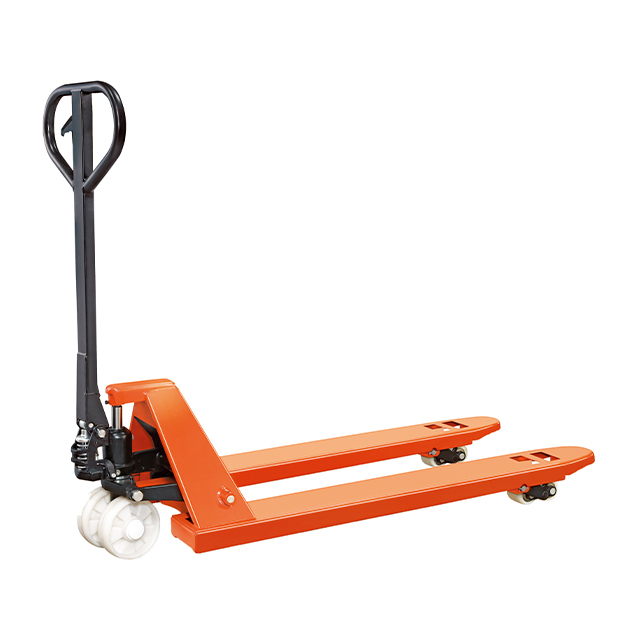
A hand pallet truck (also called a manual pallet jack) is operated by pumping the tiller handle to lift the forks and then walking with the load. On flat, smooth warehouse floors, pushing is almost always the safer and more controllable method.
Here's what that looks like in practice:
Position yourself behind the tiller handle, facing the direction of travel
Use your body weight to drive the movement forward, letting your legs do the work
Keep your back straight and avoid hunching over the handle
Maintain a clear sightline to your destination before you start moving
The only time pulling a hand pallet truck is acceptable is when you're navigating a ramp or incline. On a downward slope, walking behind the truck while controlling it with the handle gives you better braking control and prevents the load from rolling away from you. On an upward slope, pulling the truck up while facing it allows you to manage resistance more safely.
Outside of inclines, stick to pushing.
An electric pallet truck removes the manual effort of moving heavy loads but introduces a different set of considerations. Because the machine drives itself, the operator is largely responsible for steering and direction.
Most electric pallet trucks are designed to be walked behind or ridden, with the operator at the rear of the machine. This configuration is effectively a pushing setup—the machine moves forward, and the operator walks or stands behind it.
For pedestrian-operated electric pallet trucks:
Walk behind the machine, using the tiller arm to steer
Keep a safe distance from the forks and wheels
Never walk in front of a moving electric pallet truck, especially with a load on the forks
Use the dead man's switch or safety handle as designed—releasing it should bring the machine to a stop
Pulling an electric pallet truck is generally not recommended and, in many cases, is not physically possible with the machine's designed configuration. Attempting to pull or walk in front of a powered machine with a load significantly increases the risk of being struck or caught between the truck and a fixed object.
One scenario where operators sometimes feel tempted to pull a pallet truck is when carrying an oversized or tall load that blocks their forward vision. This is understandable, but pulling is not the right solution.
Instead:
Get a spotter to guide you from the front
Take a different route with fewer obstacles
Break the load down into smaller sections if possible
Use mirrors or camera systems if available in your facility
Maintaining visibility is a shared responsibility between the operator and the facility's safety setup. Pulling a truck to see around a load simply trades one hazard for another.
Beyond the push vs. pull question, a few other habits can make a significant difference in day-to-day safety:
Overloading the truck: Always check the rated capacity before loading. Exceeding the limit strains the hydraulic system and increases the risk of tipping.
Moving too fast: Speed matters, especially on electric pallet trucks. Slow down around corners, pedestrian zones, and loading docks.
Ignoring floor conditions: Wet floors, uneven surfaces, and debris all increase the risk of losing control. Report and address hazards promptly.
Poor maintenance: A hand pallet truck with worn wheels or a stiff pump handle takes more effort to operate—and more effort means more strain. Keep equipment in good condition.

The push vs. pull question also connects to a broader one: which type of pallet truck is right for your operation?
Hand pallet trucks are best suited for lighter loads, shorter distances, and environments where electric equipment isn't practical. They're reliable, low-maintenance, and easy to maneuver. NIULI's range of hand pallet trucks, for example, is designed with ergonomic tiller handles and smooth hydraulic lifting to reduce operator fatigue.
Electric pallet trucks are better suited for high-volume environments, longer travel distances, and heavier loads. They remove much of the physical effort from the equation, which reduces fatigue and the risk of repetitive strain injury. NIULI's electric pallet trucks, including lithium battery models, offer efficient performance with safety features designed for demanding warehouse environments.
The right choice depends on your load weights, travel distances, floor conditions, and budget.
Pushing a pallet truck is the standard recommendation for a reason. It protects your back, gives you better control, and keeps you facing the direction of travel. Whether you're operating a hand pallet truck on a busy warehouse floor or steering an electric pallet truck through a logistics center, the principle holds.
Safe operation starts with understanding why these guidelines exist—not just following them because a sign on the wall says so. Train your team, maintain your equipment, and choose the right pallet truck for the job. Explore NIULI's full range of hand pallet trucks and electric pallet trucks at chinaniuli.com to find the right solution for your operation.