
Views: 0 Author: Site Editor Publish Time: 2026-02-26 Origin: Site


Moving heavy loads across a warehouse floor requires the right equipment. Pallet trucks have become essential tools in warehouses, distribution centers, and retail environments worldwide. But how exactly do these workhorses of material handling operate?
Understanding the mechanics behind pallet trucks can help you choose the right equipment for your needs, operate it safely, and maintain it properly. This guide breaks down everything you need to know about how pallet trucks work, from basic manual models to advanced electric versions.
A pallet truck, also known as a pallet jack or pump truck, is a wheeled cart designed to lift and move palletized loads. These compact machines typically handle weights ranging from 2,000 to 5,500 pounds, making them ideal for short-distance transportation within facilities.
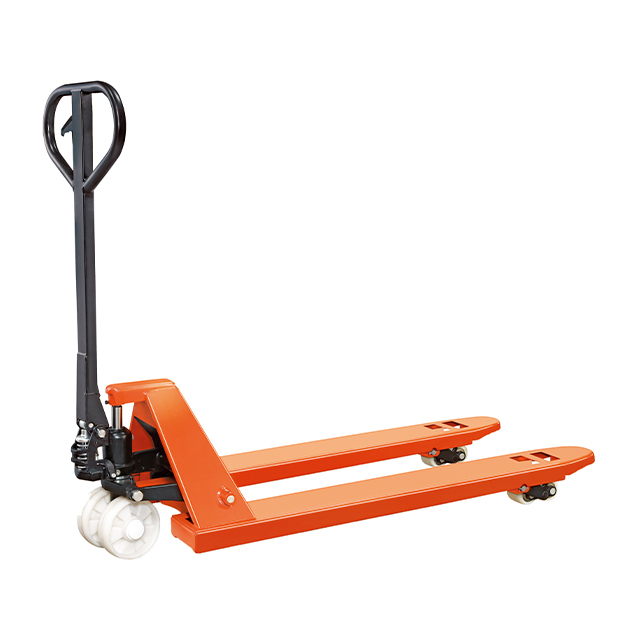
The basic design consists of two parallel forks that slide beneath a pallet, a hydraulic pump mechanism for lifting, and wheels for mobility. This simple yet effective configuration has made pallet trucks indispensable in logistics operations.
Manual pallet trucks rely on human power and hydraulic mechanics to function. They're the most common type found in warehouses due to their affordability, reliability, and ease of use.
The heart of a manual pallet truck is its hydraulic cylinder. When you pump the handle, you're activating a piston that forces hydraulic fluid into a lifting cylinder. This creates pressure that raises the forks gradually with each pump stroke.
Here's the step-by-step process:
Pumping: Moving the handle up and down activates the hydraulic pump
Pressure buildup: Each stroke forces fluid into the cylinder
Lifting: Hydraulic pressure pushes a ram upward, raising the forks
Lowering: A release lever opens a valve, allowing fluid to return and forks to descend
The hydraulic advantage means you can lift heavy loads with relatively little physical effort. A typical manual pallet truck requires 30-40 pumps to raise a load to its maximum height of about 8 inches.
Forks: The two horizontal arms that slide under pallets, typically measuring 42-48 inches long
Wheels: Usually feature two load wheels (inside the forks) and two steering wheels (at the rear)
Handle: Controls steering, pumping for lifting, and lowering via the release lever
Hydraulic pump: Converts mechanical motion into hydraulic pressure
Frame: The structural body that connects all components
Manual pallet trucks excel in environments where loads need to be moved short distances frequently. They require no batteries or fuel, making them cost-effective and low-maintenance options.
Electric pallet trucks take material handling to the next level by incorporating battery-powered motors. These machines eliminate the physical strain of pumping and pulling, significantly increasing productivity.
Electric models use rechargeable batteries to power motors that handle both lifting and propulsion. Operators control these functions through buttons or switches on the handle.
The lifting mechanism works similarly to manual versions but replaces the hand pump with an electric motor that drives the hydraulic pump. This allows loads to be raised quickly and effortlessly at the push of a button.
For movement, an electric drive motor turns the wheels. Some models are walk-behind units where operators walk alongside, while others feature a platform for the operator to ride.
Electric pallet trucks offer several benefits over manual versions:
Reduced physical strain: Operators expend far less energy, reducing fatigue and injury risk
Increased speed: Faster lifting and travel speeds boost productivity
Greater capacity: Many electric models can handle heavier loads than manual trucks
Longer distances: Ideal for facilities where loads need to travel further
Lithium battery options: Modern electric pallet trucks often feature lithium-ion batteries that charge quickly and last longer than traditional lead-acid batteries
The trade-off is higher initial cost and the need for battery charging infrastructure. However, for high-volume operations, the productivity gains typically justify the investment.


Whether manual or electric, operating a pallet truck follows a similar basic process.
Position the forks: Approach the pallet squarely and slide the forks completely underneath, ensuring they're centered
Lift the load: For manual trucks, pump the handle until the pallet clears the ground. For electric models, press the lift button
Check stability: Ensure the load is balanced and secure before moving
Pull or drive: Manual trucks are pulled backward with the operator facing the load. Electric trucks can be walked behind or ridden
Navigate carefully: Turn wide to prevent tipping, especially with tall or unbalanced loads
Watch for obstacles: Keep clear sight lines and watch for pedestrians, other equipment, and floor hazards
Position precisely: Align the pallet with its destination
Lower slowly: Use the release lever on manual trucks or the lower button on electric models
Withdraw forks: Once the pallet is fully supported by the floor or rack, pull the forks out carefully
1
Proper maintenance keeps pallet trucks operating safely and efficiently.
Inspect daily: Check wheels, forks, and hydraulic systems before each use
Keep wheels clean: Remove debris that can cause uneven rolling or damage
Check hydraulic fluid: Top up as needed and watch for leaks
Lubricate moving parts: Regular lubrication prevents excessive wear
Charge batteries properly: For electric models, follow manufacturer charging guidelines
Replace worn parts: Address damaged wheels, forks, or seals promptly
Always observe load capacity limits to prevent equipment failure or tipping. Keep hands and feet clear of the lifting mechanism and wheels. Never ride on forks or allow passengers. Wear appropriate safety footwear and high-visibility clothing in busy environments.
Training operators properly reduces accidents and equipment damage. Even though pallet trucks seem simple, proper technique matters for safety and efficiency.
The best pallet truck depends on your specific application.
Manual pallet trucks make sense for light-duty applications with low load volumes, short travel distances, and budget constraints. They're perfect for small warehouses, retail stockrooms, and occasional use.
Electric pallet trucks are worth the investment for high-volume operations, heavy loads moved frequently, longer travel distances, and workplaces focused on reducing worker strain.
Consider factors like floor surface condition, available space for maneuvering, power source availability for electric models, and whether loads need to be lifted to different heights.
Pallet trucks have revolutionized how businesses move goods. Understanding how these machines work—from the hydraulic mechanics of manual models to the powered efficiency of electric versions—helps you select the right equipment and use it effectively.
Whether you choose a manual pallet truck for its simplicity and low cost, or invest in an electric pallet truck for enhanced productivity, proper operation and maintenance ensure these reliable tools will serve your business for years.
For businesses looking to upgrade their material handling equipment, companies like NIULI Machinery offer comprehensive ranges of both manual and electric pallet trucks designed for various industrial applications.




 ELECTRIC PALLET TRUCK
  PALLET TRUCK SCALE
  AERIAL WORK PLATFORM
  DRUM TRUCK


